
Carbon Projects
District Sheikhupura, Pakistan
Registry: Gold Standard
Crediting Period: 2022 - 2026 (and extending to 2030)
Number of Farmers: 2,700
Annual Emissions Reductions: 60,000 MT per annum
District Sheikhupura is where we launched our first carbon credit project successfully in 2022, and generated the world's first Gold Standard Rice Carbon Credits.
Sheikhupura sits just 38 kilometres northwest of Lahore, at the heart of Punjab's most productive agricultural belt. It is one of Pakistan's main Basmati rice growing areas, and alongside Gujranwala, Hafizabad, and Narowal, produces world-class aromatic Basmati rice for export markets benefiting from fertile soils and a long growing season.
The district is home to 93 rice mills, a measure of just how central rice is to its economic fabric. Sheikhupura is also home to Pakistan's Rice Research Institute - making it the country's leading centre for rice science, and a natural base for pioneering studies into emissions reduction and alternate wetting and drying techniques.
For NetZeroAg, it is a district where deep agricultural heritage meets the frontier of climate-smart farming.
District Narowal, Pakistan
Registry: Gold Standard
Crediting Period: 2026 - 2030
Number of Farmers: 2000
Annual Emissions Reductions: 60,000 MT per annum
Narowal District sits at the heart of Pakistan's rice belt and farming is the lifeblood of the district, with agriculture covering over 355,000 acres and smallholder families forming the backbone of the local economy.
Narowal is particularly celebrated for the exceptional aroma of its rice. It is also a district where farming families are deeply vulnerable to the pressures of climate change - making it exactly the kind of place where NetZeroAg's work matters most.
District Mandi Bahauddin, Pakistan
Registry: Gold Standard
Crediting Period: 2026 - 2030
Annual Emissions Reductions: 60,000 MT per annum
Mandi Bahauddin takes its name from the word "mandi" - meaning grain market - a fitting origin for a district that has been a centre of agricultural trade for centuries.
Situated in the Chaj Doab region between the Jhelum and Chenab rivers, the district sits within Punjab's rice-wheat agro-ecological zone. Agriculture engages over 40% of the population across roughly 310,000 hectares of arable land. Rice cultivation across the district covers 84,000 hectares, producing close to 180,000 tonnes annually - driven by both Basmati and coarse varieties well suited to local conditions.
Yet Mandi Bahauddin's farmers are navigating a shifting agricultural calendar - with heat arriving earlier, monsoons concentrating into shorter windows, and the rhythms that once guided planting and harvest becoming harder to predict.
It is precisely this intersection of deep farming heritage and growing climate vulnerability that makes Mandi Bahauddin a natural home for NetZeroAg's work.


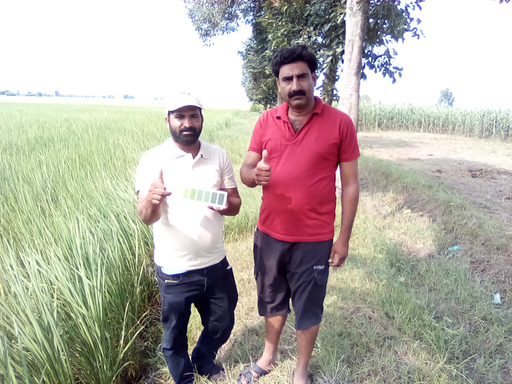
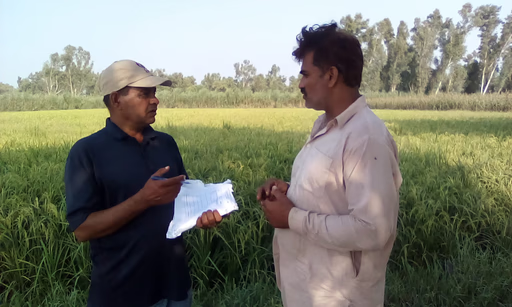


.jpeg)
Cambodia
Registry: Gold Standard
Crediting Period: 2025 - 2029
Number of Farmers: 3000
Annual Emissions Reductions: 43,000 MT per annum
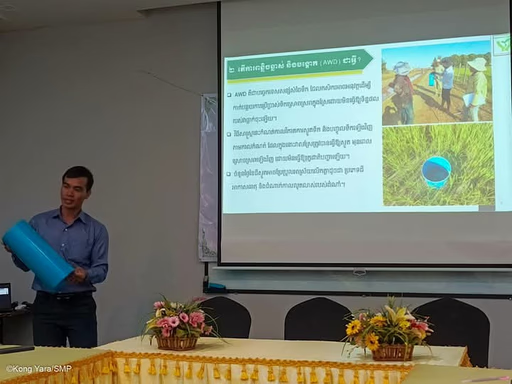
In partnership with SMP Cambodia, we're bringing the same rigour that built our Pakistan programme to Southeast Asia's rice heartland. We started with a pilot of 100 farmers, and laid the foundation for a project that can scale across the region.
The science is the same. The stakes are the same. The farmers are different, and their stories are just beginning.


Interested in what we're building?
Sustainable Rice
Traceable, lower-emission rice grown with farmers who've adopted better practices.
Carbon Credits
High-integrity, Gold Standard-certified credits backed by rigorous field measurement.
Partner With Us
Whether you're a food company, investor, or institutional partner — there's a role here.